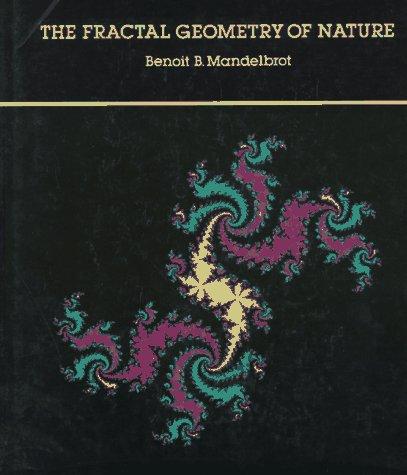
The Fractal Geometry of Nature
The Book
The opening sentence is one of the most famous in mathematics:
“Clouds are not spheres, mountains are not cones, coastlines are not circles, and bark is not smooth, nor does lightning travel in a straight line.”
— Benoit B. Mandelbrot
With that single declaration, Mandelbrot indicted three centuries of geometry. Euclid gave us points, lines, planes, and spheres — shapes that describe almost nothing in the natural world. The geometry taught in schools is a geometry of idealization. Trees are not cylinders. Rivers are not parabolas. The surface of a mountain, examined at any scale, reveals more roughness, not less. Mandelbrot’s proposition was radical: nature’s roughness is not noise to be smoothed away. It is signal. It has structure. And that structure can be described mathematically — by a new geometry he called fractal.
The Fractal Geometry of Nature is the expanded and revised edition of his earlier Fractals: Form, Chance, and Dimension (1977). It is part manifesto, part encyclopedia, and part art book. Mandelbrot catalogs the fractal geometry of coastlines, rivers, clouds, galaxies, turbulence, polymers, lungs, trees, and market prices. Each chapter extends the same thesis: simple iterative rules, applied recursively, produce the staggering complexity of the natural world. The book is dense, discursive, and occasionally maddening in its scope — Mandelbrot himself called it “a casebook and a manifesto” rather than a textbook. But its core insight transformed mathematics, computer graphics, physics, biology, finance, and the way we see the world.
The Mathematician
Benoit B. Mandelbrot (1924–2010) was born in Warsaw to a Lithuanian Jewish family of scholars. His uncle, Szolem Mandelbrojt, was a professor of mathematics at the Collège de France and a member of the Bourbaki group — the formalist collective that dominated French mathematics. When Benoit was eleven, the family fled Poland for France. He survived the German occupation in hiding, educated himself sporadically, and developed an extraordinary visual intuition for mathematical structure that set him apart from the algebraic formalism of his peers.
Mandelbrot studied at the École Polytechnique in Paris under Gaston Julia — whose work on iterated functions in the complex plane would, decades later, become the foundation for the Mandelbrot set. He completed his doctorate at the University of Paris, spent a postdoctoral year at Caltech with Theodore von Kármán, and then joined IBM’s Thomas J. Watson Research Center in 1958. He stayed at IBM for thirty-five years.
IBM was the perfect environment for Mandelbrot. The corporate research lab gave him freedom to roam across disciplines without the territorial constraints of a university department. He studied noise in telephone lines, the distribution of word frequencies in natural language, the flooding patterns of the Nile, the clustering of galaxies, the geometry of coastlines, and the distribution of cotton prices — all seemingly unrelated problems that turned out to share the same underlying mathematics. In 1975 he coined the word “fractal” from the Latin fractus, meaning broken or fragmented. In 1980, using IBM’s computers, he generated the first visualizations of the set that bears his name — the Mandelbrot set, produced by iterating z = z² + c in the complex plane. The infinitely detailed boundary of that set became one of the most iconic images in all of mathematics. He later became Sterling Professor of Mathematical Sciences at Yale, a position he held until his death in 2010.
The Ideas
Self-Similarity
The defining property of a fractal is self-similarity: the object looks similar at different scales. Break a piece off a cauliflower and it resembles the whole cauliflower. Zoom into a coastline on a map and the jagged detail at the new scale looks statistically like the jagged detail at the old scale. This is not approximate or metaphorical. Mandelbrot showed that the statistical properties of many natural forms are genuinely invariant across scales — a property he called “scaling.” The mathematics of self-similarity had been studied in pure form by Cantor, Peano, Sierpiński, and Koch in the late nineteenth and early twentieth centuries, but these were treated as pathological curiosities — “monsters” that violated well-behaved geometry. Mandelbrot’s insight was that these monsters are everywhere. They are not exceptions to the rules of nature. They are the rules of nature.
Fractal Dimension
In Euclidean geometry, a line has dimension 1, a plane has dimension 2, a solid has dimension 3. Mandelbrot introduced the concept of fractional dimension — a coastline, for instance, is more than a line but less than a plane. Its fractal dimension, measured using the Hausdorff-Besicovitch method, falls between 1 and 2. The more convoluted the coastline, the higher its fractal dimension. This was not an abstract exercise. Mandelbrot showed that fractal dimension is a measurable, physically meaningful quantity that characterizes the roughness of natural objects.
| Natural Object | Fractal Dimension |
|---|---|
| Coastline of Britain | ~1.25 |
| Coastline of Norway | ~1.52 |
| Surface of the human lung | ~2.97 |
| Romanesco broccoli | ~2.66 |
| Brownian motion trail | ~2.0 |
| Lightning bolt | ~1.51 |
| Fern leaf boundary | ~1.7 |
The Coastline Paradox
The coastline paradox, which Mandelbrot formalized from the empirical work of Lewis Fry Richardson, is the most intuitive entry point to fractal geometry. How long is the coast of Britain? The answer depends entirely on the length of your measuring stick. Measure with a 200-kilometer ruler and you get one number. Measure with a 50-kilometer ruler and you get a significantly larger number, because the shorter ruler follows more of the inlets and headlands. Measure with a 1-meter ruler and the number is larger still. As the ruler shrinks toward zero, the measured length grows without bound. The coastline has no well-defined length. It is, in Mandelbrot’s framework, a fractal curve with dimension greater than 1.
Richardson had empirically discovered this effect in the 1950s while studying the relationship between border length measurement and the probability of interstate wars. He plotted the measured length of national borders against ruler size on a log-log scale and found straight lines — power laws. Mandelbrot recognized these power laws as the signature of fractal geometry and gave them a rigorous mathematical foundation.
A Catalog of Fractals in Nature
The book’s central ambition is taxonomic. Mandelbrot walks through domain after domain, demonstrating that fractal structure is not an occasional curiosity but a universal organizing principle. River networks are fractal — tributaries branch from rivers in the same statistical pattern that sub-tributaries branch from tributaries. The distribution of galaxies in the universe exhibits fractal clustering. Turbulent fluid flow produces fractal eddies within eddies. The branching of the human vascular system is fractal. The surface of a mountain is a fractal landscape. Even the distribution of earthquake magnitudes follows a power law — the Gutenberg-Richter law — that Mandelbrot identified as fractal in character.
“I claim that many patterns of Nature are so irregular and fragmented, that, compared with Euclid — a term used in this work to denote all of standard geometry — Nature exhibits not simply a higher degree but an altogether different level of complexity.”
— Benoit B. Mandelbrot
L-Systems and the Geometry of Plants
In 1968, the Hungarian biologist Aristid Lindenmayer introduced a formal system for modeling the growth of plants. His L-systems — short for Lindenmayer systems — use a deceptively simple mechanism: a starting string (the axiom), a set of rewriting rules, and iteration. At each step, every character in the string is simultaneously replaced according to the rules. The resulting string is then interpreted as instructions for a “turtle” — a cursor that moves forward, turns, and can save and restore its position using a stack (the bracket symbols [ and ]).
The connection to Mandelbrot’s program is direct: L-systems demonstrate that the complex geometry of plants — branching trees, fern fronds, flowering bushes — emerges from the recursive application of simple rules. A fern frond is not designed in its entirety. It grows from a rule applied at every scale: each branch produces sub-branches in the same pattern. This is self-similarity in action. The fractal dimension of the resulting form is determined by the angle, the branching ratio, and the number of iterations — not by any blueprint of the final shape.
Przemysław Prusinkiewicz and Aristid Lindenmayer’s The Algorithmic Beauty of Plants (1990) extended this work into a comprehensive computational framework, generating strikingly realistic models of plant morphology from L-system grammars. Their work confirmed Mandelbrot’s thesis at the biological level: the geometry of nature is generated, not designed.
The interactive Fractal Explorer below lets you explore these ideas directly. Generate L-system plants and geometric fractals, trace rose curves and spirals from polar equations, or dive into the infinite boundary of the Mandelbrot set. Each pattern is produced by the same principle Mandelbrot identified — simple rules, iterated without end. The complexity you see is not encoded anywhere. It emerges.
X
Rules: X→F+[[X]-X]-F[-FX]+X, F→FF
String length: 0
Where It All Went
Computer Graphics
The most immediate impact of Mandelbrot’s work was in computer graphics. In 1980, Loren Carpenter at Boeing created a two-minute film called Vol Libre that used fractal algorithms to generate photorealistic mountain landscapes. The film was shown at SIGGRAPH and led directly to Carpenter joining Lucasfilm, where fractal techniques were used to generate the Genesis planet sequence in Star Trek II: The Wrath of Khan (1982) — the first entirely computer-generated sequence in a feature film. Carpenter co-founded Pixar. Today, fractal noise (Perlin noise, simplex noise, and their fractal variants) is the foundation of procedural terrain, cloud, and texture generation in virtually every 3D rendering engine, from Unreal to Blender to the landscape generators behind open-world games.
Biology
The fractal branching of the human lung allows approximately 300 million alveoli — with a total surface area of roughly 70 square meters — to pack into a chest cavity of about 6 liters. Evolution arrived at fractal geometry long before Mandelbrot named it. The vascular system, the nervous system, and the bronchial tree all exhibit fractal branching that maximizes surface area within constrained volumes. Michael Barnsley’s Fractals Everywhere (1988) formalized the iterated function systems (IFS) that generate fern-like structures, and West, Brown, and Enquist’s 1997 model of metabolic scaling across species used fractal network geometry to explain why metabolic rate scales as the 3/4 power of body mass across organisms ranging from bacteria to whales.
Finance
Mandelbrot’s 1963 paper on cotton prices was the first application of fractal geometry to financial markets. He showed that price changes followed Lévy stable distributions with power-law tails — not the Gaussian distributions assumed by modern portfolio theory. This work, largely ignored for decades, eventually became the foundation of his book The (Mis)Behavior of Markets (2004), which argued that standard financial models catastrophically underestimate the probability of extreme events. The 2008 financial crisis proved him right. Today, an entire industry of tail-risk hedging — funds like Universa Investments, which returned 4,144% during the March 2020 COVID crash — is built on the insight that market returns are fractal, not Gaussian.
Fractal Antennas
Nathan Cohen’s invention of the fractal antenna in 1988 exploited the self-similar geometry Mandelbrot described to create antennas that are multiband and compact. A Sierpiński gasket or Koch curve antenna resonates at multiple frequencies because its self-similar structure contains features at multiple scales. Fractal antenna designs are now embedded in virtually every smartphone — enabling the device to operate across cellular, Wi-Fi, Bluetooth, and GPS bands from a single compact element. Cohen founded Fractal Antenna Systems, Inc., and the technology has been adopted in military communications, satellite systems, and RFID.
The Fractal Geometry of Nature changed how we see the world. Before Mandelbrot, roughness was noise — an inconvenience to be smoothed away by idealized models. After Mandelbrot, roughness became signal — measurable structure with its own mathematics. The book is not easy. It is sprawling, opinionated, and occasionally self-congratulatory. Mandelbrot knew he was right, and he wanted you to know it too. But the scope of his vision is staggering. From the coastline of Britain to the distribution of galaxies, from the branching of trees to the turbulence of rivers, from the clustering of errors in telephone lines to the wild swings of financial markets — a single mathematical framework unifies phenomena that had been treated as unrelated for centuries.
The deepest lesson of the book is generative: complexity does not require complex rules. A fern grows from a single recursive instruction. A coastline emerges from erosion acting at every scale. A galaxy cluster forms from gravity operating on a power-law distribution of masses. The geometry of nature is not designed from the top down. It is grown from the bottom up, by simple rules iterated without end. Mandelbrot gave us the mathematics to see it — and, as the Fractal Explorer above demonstrates, to build it ourselves.
“Bottomless wonders spring from simple rules, which are repeated without end.”
— Benoit B. Mandelbrot